The best LED light for a planted tank
If you want the short version: the best LED light for most planted tanks is the Best overall pick — a full-spectrum LED with app or dimmer control that grows the full plant range, low-tech or high-tech, in tanks from 20 to 75 gallons. The best low-tech pick is the Best for low-tech, and the best budget option is the Best budget.
The light is what makes a planted tank a planted tank. Get it wrong and you grow algae instead of plants — no amount of dosing fixes a light mismatched to the tank. The good news is that planted-tank LEDs in 2026 are better and cheaper than they have ever been. A mid-priced LED today outperforms premium fixtures from a decade ago. Get the spec right and a single $150 light grows plants for the rest of the decade.
Specs verified against manufacturer listings and Amazon. I have personally run two of the lights in this comparison over the years — the slot 3 high-tech pick over my own 60-gallon tank for about three years, and the slot 5 nano pick on a shrimp tank for two. These notes lean on that hands-on time plus the published PAR data and a careful read of hobbyist forums.
Quick comparison
Six planted-tank LEDs, side by side on the specs that decide the purchase. Wattage, spectrum, control method, the tank depth each light suits, and the price band.
| Best for | Wattage | Spectrum | Adjustable / controller | Best tank depth | Price |
|---|---|---|---|---|---|
| Best overall | 22 W | Six unique band waves, full-spectrum (white + RGB + plant-growth) | Bluetooth app + programmable 24-hour cycle (sunrise, midday, sunset, night); preset habitat modes | Up to ~18 in for mid-light planted tanks; pairs with 10–20 G kits | $149.99 |
| Best for low-tech | ~26 W (HLC-20) | 4-channel (white, blue, green, true 660 nm deep red), full-spectrum | Wireless remote + built-in sensor; fully customisable 24/7 sunrise/sunset cycle | Up to ~16–18 in low-to-medium light | $84.99 |
| Best for high-tech | 37 W (30 cm model); range across sizes: 37–138 W | Full-spectrum WRGB, separately tunable red/green/blue channels | Bluetooth + ‘My Chihiros’ app — sunrise/sunset and custom curves | High-tech / CO2-injected tanks up to ~50 cm depth | $270.59 |
| Best budget | 21 W | 6500K white + 450 nm blue + true 660 nm deep red + green; CRI 91 | Inline timer, 15- or 30-minute ramp-up/dim-down, daylight + moonlight cycle | Low-to-medium light planted tanks; pairs with 20 G long or 29 G | $52.99 |
| Best for nano | 7 W (18 × 0.38 W LEDs) | 8000K daylight white, 750 lumens | Inline manual dimmer | Nano cubes / 20 cm tanks — shallow rimless | $31.89 |
| Best premium | 125 W | Spectrum V3.0 full-spectrum 400–780 nm (WRGB + plant-growth LEDs), 7,600 lm | Bluetooth + LightControl Pro app — 4-channel tuning, Boost Mode, 60-min sunrise/sunset | 48"/120 cm class tanks — high-tech display aquariums | $456.99 |
Our top picks
Six picks, each matched to a buyer situation. Read the one that sounds like you — the "best for" tag at the top of each box is doing real work.
Best overall: Fluval Plant 3.0 LED Planted Aquarium Lighting, 22 W, 15–24 in

Best overall
Fluval Plant 3.0 LED Planted Aquarium Lighting, 22 W, 15–24 in
Fluval
- Wattage: 22 W
- Spectrum: Six unique band waves, full-spectrum (white + RGB + plant-growth)
- Adjustable / controller: Bluetooth app + programmable 24-hour cycle (sunrise, midday, sunset, night); preset habitat modes
- Mounting: Extendable mounting brackets, 120° dispersion
- Best tank depth: Up to ~18 in for mid-light planted tanks; pairs with 10–20 G kits
The Fluval Plant 3.0 is the hobby’s default ‘good light for planted tanks’ — app-controlled, full-spectrum and tunable per plant load.
Last checked 2026-05-19
The default planted-tank LED for almost any 20-to-75-gallon build. Full-spectrum output, dimmable intensity, app or timer control, and PAR figures that scale cleanly across low-tech and high-tech. The intensity is high enough to grow the demanding species when CO2 is added, low enough at half power for the easy plant shortlist without CO2. This is the light most planted-tank keepers should buy first.
Who it is for: a flexible build where the keeper might run low-tech now and add CO2 later. What to watch: the adjustable intensity is only useful if you actually tune it. Out of the box the default settings tend to be too bright for a low-tech tank — start at 50 percent and ramp up if plant growth stalls.
Best for low-tech: Finnex Planted+ True 24/7 + HLC Aquarium LED Light, 20 in (HLC-20)

Best for low-tech
Finnex Planted+ True 24/7 + HLC Aquarium LED Light, 20 in (HLC-20)
Finnex
- Wattage: ~26 W (HLC-20)
- Spectrum: 4-channel (white, blue, green, true 660 nm deep red), full-spectrum
- Adjustable / controller: Wireless remote + built-in sensor; fully customisable 24/7 sunrise/sunset cycle
- Mounting: Adjustable docking mounts for rimmed or rimless tanks
- Best tank depth: Up to ~16–18 in low-to-medium light
The Planted+ 24/7 HLC keeps the proven Finnex spectrum but adds the HLC controller — set-and-forget sunrise to sunset, perfect for a low-tech anubias/cryptocoryne tank.
Last checked 2026-05-19
The low-tech pick. A planted-tank LED with moderate output, full-spectrum coverage, and the right brightness for the easy plant shortlist (anubias, java fern, cryptocoryne, hornwort, swords, vallisneria) without inviting algae. Simpler than the slot 1 pick and meaningfully cheaper — the right answer for a build that will stay low-tech.
Who it is for: a low-tech-only build, a quarantine tank, or a secondary planted tank where the primary tank gets the premium light. What to watch: this light does not have the headroom for high-tech plants. If you plan to add CO2 within the first year, step up to the slot 1 pick.
Best for high-tech: Chihiros WRGB II PRO LED Aquarium Light, Bluetooth App Control, 30 cm

Best for high-tech
Chihiros WRGB II PRO LED Aquarium Light, Bluetooth App Control, 30 cm
Chihiros
- Wattage: 37 W (30 cm model); range across sizes: 37–138 W
- Spectrum: Full-spectrum WRGB, separately tunable red/green/blue channels
- Adjustable / controller: Bluetooth + ‘My Chihiros’ app — sunrise/sunset and custom curves
- Mounting: Adjustable stainless steel legs
- Best tank depth: High-tech / CO2-injected tanks up to ~50 cm depth
WRGB II PRO is the workhorse high-tech light for CO2-injected, demanding-plant tanks — up to 11,170 lm and per-channel colour tuning from the app.
Last checked 2026-05-19
The high-tech pick. A premium planted-tank LED with full RGB spectrum control, high PAR output at depth, and the kind of intensity that supports demanding carpet plants (Monte Carlo, dwarf hairgrass) and the red stem species. Mandatory pairing with pressurised CO2 — the light alone, without CO2, just feeds algae faster.
Who it is for: a serious aquascape, a competition build, or a high-tech 20-to-90 gallon tank with CO2 and weekly EI dosing. What to watch: the high intensity needs tuning. Start at lower brightness and ramp up over weeks as plants establish, or you will spend the first month battling algae.
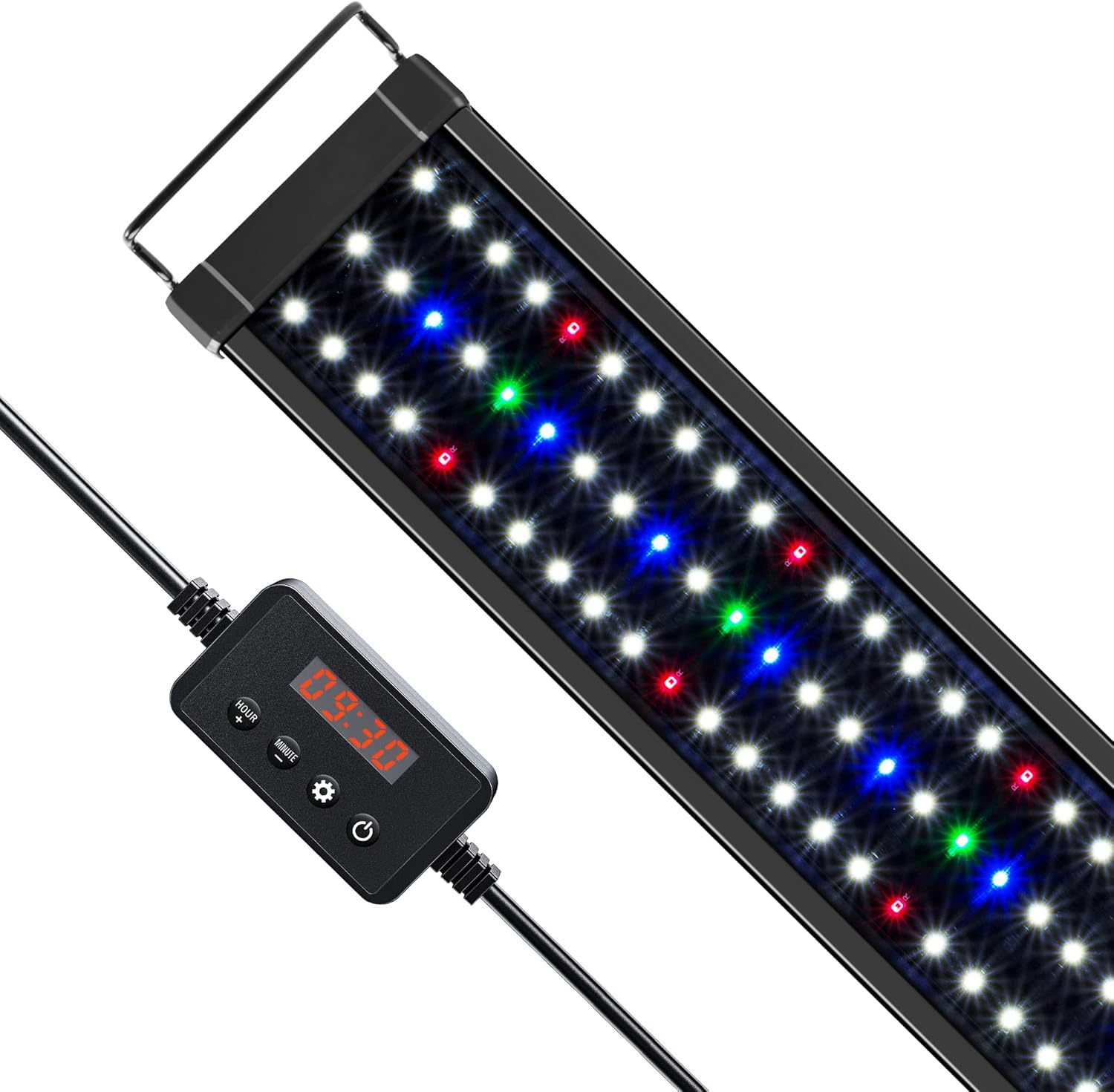
Best budget: NICREW ClassicLED Plus LED Aquarium Light with Timer, 21 W, for 30–36 in Fish Tank
Best budget
NICREW ClassicLED Plus LED Aquarium Light with Timer, 21 W, for 30–36 in Fish Tank
NICREW
- Wattage: 21 W
- Spectrum: 6500K white + 450 nm blue + true 660 nm deep red + green; CRI 91
- Adjustable / controller: Inline timer, 15- or 30-minute ramp-up/dim-down, daylight + moonlight cycle
- Mounting: Adjustable docking mounts (rimless or framed)
- Best tank depth: Low-to-medium light planted tanks; pairs with 20 G long or 29 G
Best-in-class for under $60 — a true full-spectrum bar with timer, ramp lighting and high CRI for plant colour rendition. The default budget recommendation.
Last checked 2026-05-19
The budget pick. A planted-tank LED at a meaningful price discount, with adequate spectrum coverage and enough PAR to grow the easy plant shortlist. The trade-off is intensity — this light hits the low-end of usable PAR at substrate depth in anything deeper than 18 inches. For 10-to-20 gallon tanks at standard depth it performs well; for deeper tanks plan to upgrade.
Who it is for: a first build on a tight budget, a multi-tank keeper needing lighting for additional tanks, or a backup light. What to watch: spectrum is fine for low-tech but not high-tech — do not pair this with pressurised CO2 expecting premium-tier plant growth.
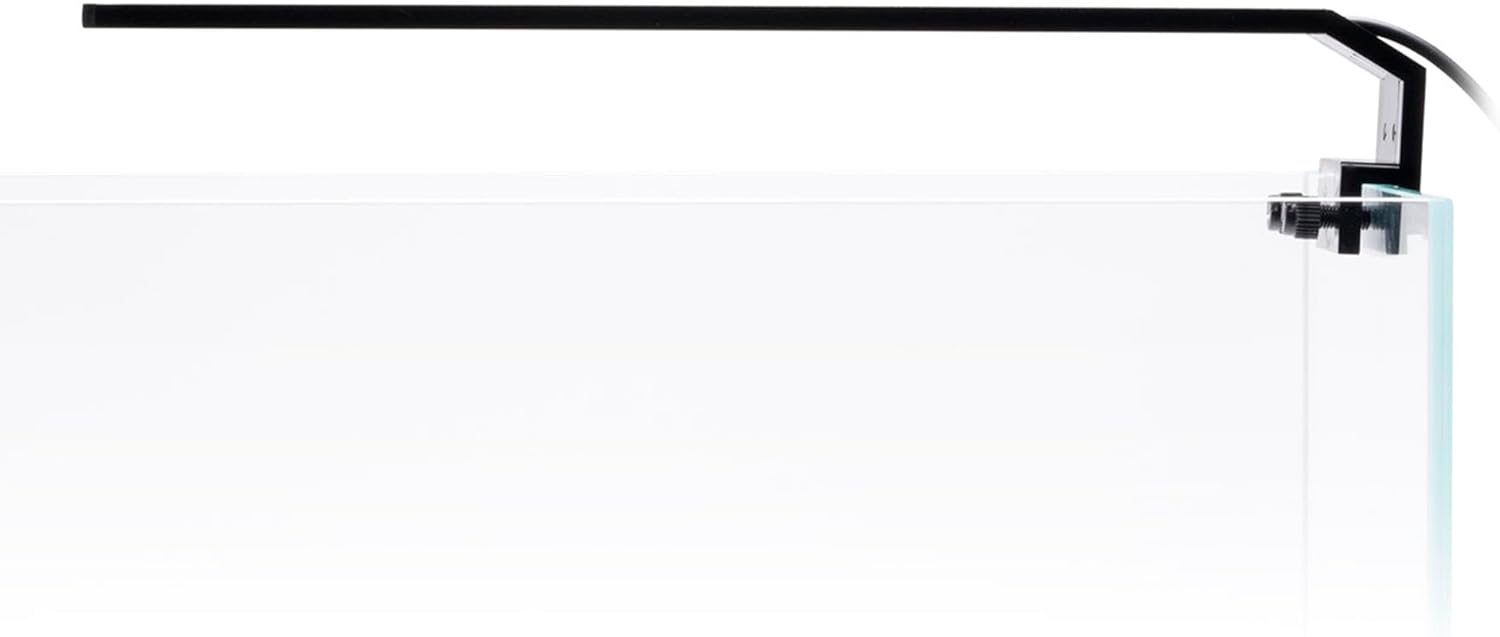
Best for nano: Chihiros C201 Aquarium LED Light — Compact Fish Tank Light with Dimmer
Best for nano
Chihiros C201 Aquarium LED Light — Compact Fish Tank Light with Dimmer
Chihiros
- Wattage: 7 W (18 × 0.38 W LEDs)
- Spectrum: 8000K daylight white, 750 lumens
- Adjustable / controller: Inline manual dimmer
- Mounting: Clip-on, compact 140 × 40 × 5 mm housing
- Best tank depth: Nano cubes / 20 cm tanks — shallow rimless
Tiny, dimmable, single-channel — the cheapest way to put a real planted-tank light on a 5-gallon Spec or a Walstad jar.
Last checked 2026-05-19
The nano pick. A compact planted-tank LED designed for tanks 10 gallons and under, with full-spectrum output, app or dimmer control, and the right form factor for a small footprint. The intensity is calibrated for shallow tanks; using it on a larger tank will leave the substrate dim and plants stretching for light.
Who it is for: a nano-tank build, a shrimp tank, a desk aquascape. What to watch: this light's intensity at shallow depth can be too bright if you run it at full output — start at half power and ramp up. Algae on nano tanks moves fast because the water volume is small.
Best premium: TWINSTAR S Line 1200S WRGB LED Aquarium Light for Planted Aquariums, Full Spectrum 400–780 nm, Bluetooth, for 48" Tanks

Best premium
TWINSTAR S Line 1200S WRGB LED Aquarium Light for Planted Aquariums, Full Spectrum 400–780 nm, Bluetooth, for 48" Tanks
Twinstar
- Wattage: 125 W
- Spectrum: Spectrum V3.0 full-spectrum 400–780 nm (WRGB + plant-growth LEDs), 7,600 lm
- Adjustable / controller: Bluetooth + LightControl Pro app — 4-channel tuning, Boost Mode, 60-min sunrise/sunset
- Mounting: Extendable legs, max span 51.2 in (130 cm)
- Best tank depth: 48"/120 cm class tanks — high-tech display aquariums
The Twinstar S Line 1200S is the flagship-tier planted-tank light on Amazon — full-spectrum WRGB plus plant-specific LEDs, app control, and the build quality to anchor a 48-inch display scape.
Last checked 2026-05-19
The premium pick. The top-tier planted-tank LED for keepers who want the best spectrum tuning, the highest PAR, and the cleanest aesthetic. Built for serious aquascape and competition tanks — the kind of light you see hanging over Dutch and Iwagumi tanks in hobbyist showcase photos. Mandatory pairing with CO2 and EI dosing; without them, the intensity outpaces what the plants can use.
Who it is for: a long-term, high-tech aquascape where the lighting is a deliberate part of the design. What to watch: this light demands a properly cycled, heavily planted, CO2-injected tank. On anything less, it just feeds algae. The cost is the cost — for a typical first build, the slot 1 or slot 3 pick is the better fit.
What to look for in a planted-tank LED
Manufacturer copy sells the photo. Here is the spec checklist worth running on any LED listing before you commit.
Published PAR data at common tank depths
A planted-tank LED worth buying publishes PAR figures at 12, 18 and 24 inches — sometimes 30. A "fish-tank" LED publishes only lumens and Kelvin. Lumens tells you how bright the light looks to your eye, not what your plants photosynthesise from. PAR is the photosynthetic figure that matters. If the listing skips it, plan to skip the light.
Full or near-full spectrum
Look for spectrum charts on the product page or manufacturer site. Quality planted-tank LEDs deliver red, green, blue and white across the 400 to 700 nm photosynthetic range. Single-colour or warm-white-only LEDs grow plants poorly and algae well.
Dimmable intensity
A dimmer or app lets you tune output to your plant load and tank depth. A non-dimmable light forces you to either run it at full power (algae risk on low-tech) or accept a mismatch between light and plants. Dimmability is the single most useful feature on a modern planted-tank LED.
Mounting flexibility
Adjustable legs that sit on a tank rim, brackets for a rimless tank, or hanging hardware for pendant-style installs. The light should fit your tank format, not the other way around. Hanging gives the most flexibility — you can move the light closer or farther from the water to fine-tune intensity.
Timer or app control
A built-in timer (or compatible app) lets you set a consistent photoperiod and a ramp from dim to bright at dawn / bright to dim at dusk. The ramp matters less than the consistent schedule — but the schedule itself is non-negotiable. Plants thrive on consistency.
LED size by tank dimensions
The right LED depends on tank depth and length. As a rough guide:
- 10–20 gallons, 12–13 in deep — 20–30 W planted-tank LED, single fixture.
- 20-long, 12 in deep — 25–35 W LED at the right spectrum, single fixture.
- 29–55 gallons, 18 in deep — 35–55 W LED, single fixture if long enough.
- 55–90 gallons, 21+ in deep — 50–80 W LED, often two fixtures side by side.
- Above 90 gallons, 24+ in deep — Multiple fixtures or a pendant-style high-output LED.
Match the fixture length to the tank length so the light spreads evenly. A fixture significantly shorter than the tank leaves dim spots; significantly longer overhangs and wastes light over the rim.
What we don't recommend
Single white-LED-strip "aquarium lights"
Anything labelled "aquarium light" or "fish tank light" that does not publish a spectrum chart or PAR figures. They usually run heavy on white and red, light on blue, and grow algae faster than plants. Spend the same money on an entry-level planted-tank-specific LED.
Household LED bulbs in a hood
Tempting and cheap. The spectrum is wrong, the PAR is unknown, and the light is not water-resistant in a way that matters above an aquarium. Skip — household LEDs grow algae.
"Marine" or "reef" LEDs on a planted tank
Marine LEDs are heavy on blue (royal blue, actinic), tuned for coral fluorescence. They do not grow freshwater plants well — too much blue, not enough red and green. The reverse is also true: do not use a planted-tank LED on a reef tank. Spectrum is purpose-built.
Frequently asked questions
How many watts per gallon does a planted aquarium need?
Wattage per gallon is an outdated rule. Modern LED lights deliver wildly different PAR (photosynthetically active radiation) per watt. What matters is the PAR at the substrate — about 20 to 40 PAR for low-tech, 40 to 80 PAR for high-tech with CO2. Look for lights that publish PAR figures at common tank depths.
How long should the light be on in a planted aquarium?
Six to eight hours a day on a timer. Less than six and plant growth stalls; more than eight without CO2 and you feed algae. Most planted-tank keepers run six hours for the first month, then ramp to seven or eight once plants are growing. A built-in timer or a smart plug makes this consistent.
Do I need a full-spectrum LED for plants?
Yes. A planted-tank LED with a full or near-full spectrum (red, green, blue across the visible range) grows plants better than a single-colour or warm-white LED. Look for spectrum charts in the product listing — if the listing only quotes Kelvin or lumens, the light is probably not a planted-tank fixture.
What is PAR and why does it matter for aquarium plants?
PAR stands for photosynthetically active radiation — the light wavelengths between 400 and 700 nm that plants actually use for photosynthesis. PAR at the substrate is the figure that matters; PAR at the surface is less relevant because water absorbs light with depth. Quality planted-tank LEDs publish PAR data at 12, 18 and 24 inches.
How do I know if my planted tank has too much light?
The clearest sign is algae on the glass and leaves within a week of setup, especially if plants are growing slowly or not at all. Other signs: dark green spot algae on leaves, hair algae on hardscape, and rapid green-water blooms. The fix: shorten the photoperiod by an hour, plant more fast-growers, and add weekly fertiliser dosing.
Can I use a regular LED bulb for a planted tank?
No. Household LED bulbs run heavy on white and red and skip the blue and full-spectrum bands that plants need. They will grow algae more readily than plants. Spend the same money on an entry-level planted-tank fixture (NICREW, Finnex Stingray) for proper spectrum.
What is the best LED for a low-tech planted tank?
A moderate-output planted-tank LED with adjustable spectrum and a timer — the slot 2 pick in this comparison. PAR in the 20 to 40 range at the substrate is plenty for the easy plant shortlist (anubias, java fern, cryptocoryne, hornwort, swords, vallisneria). Brighter than that without CO2 invites algae.
Do planted-tank LEDs need controllers or apps?
Helpful, not required. A dimmer or app lets you tune intensity to your plant load and ramp the light up and down to mimic dawn and dusk. A timer at the outlet works for the basic on/off cycle. App-controlled lights are most useful for high-tech tanks where the photoperiod is precisely tuned to CO2 injection.
How do I mount a planted-tank LED?
Three options. Adjustable legs that sit on the tank rim (most common on aluminium-housed fixtures). Mounting brackets that clip over a rimless tank. Hanging from a kit (chains or wire from above) for aquascape-focused builds. Hanging gives the cleanest look and the most flexibility on intensity (move closer/farther from the water).
Are expensive LED lights worth the money?
For high-tech tanks, yes — the spectrum tuning and the dimmability earn their keep. For low-tech tanks, a mid-priced LED with adjustable spectrum performs almost as well as a premium one. Most keepers should start with the slot 1 or slot 2 pick, not the premium one. The big upgrade comes when you add CO2.